From Painted Signs to Digital Screens: The Evolution of Out-of-Home Advertising
Discover how out-of-home advertising began, why it was created, how it evolved from posters and billboards to digital screens, and what current industry statistics reveal about OOH today.
Long before social media feeds, search engines, television commercials, or even radio, businesses needed a way to reach people beyond the walls of a store. The solution was simple but powerful: place a message where the public was already moving.
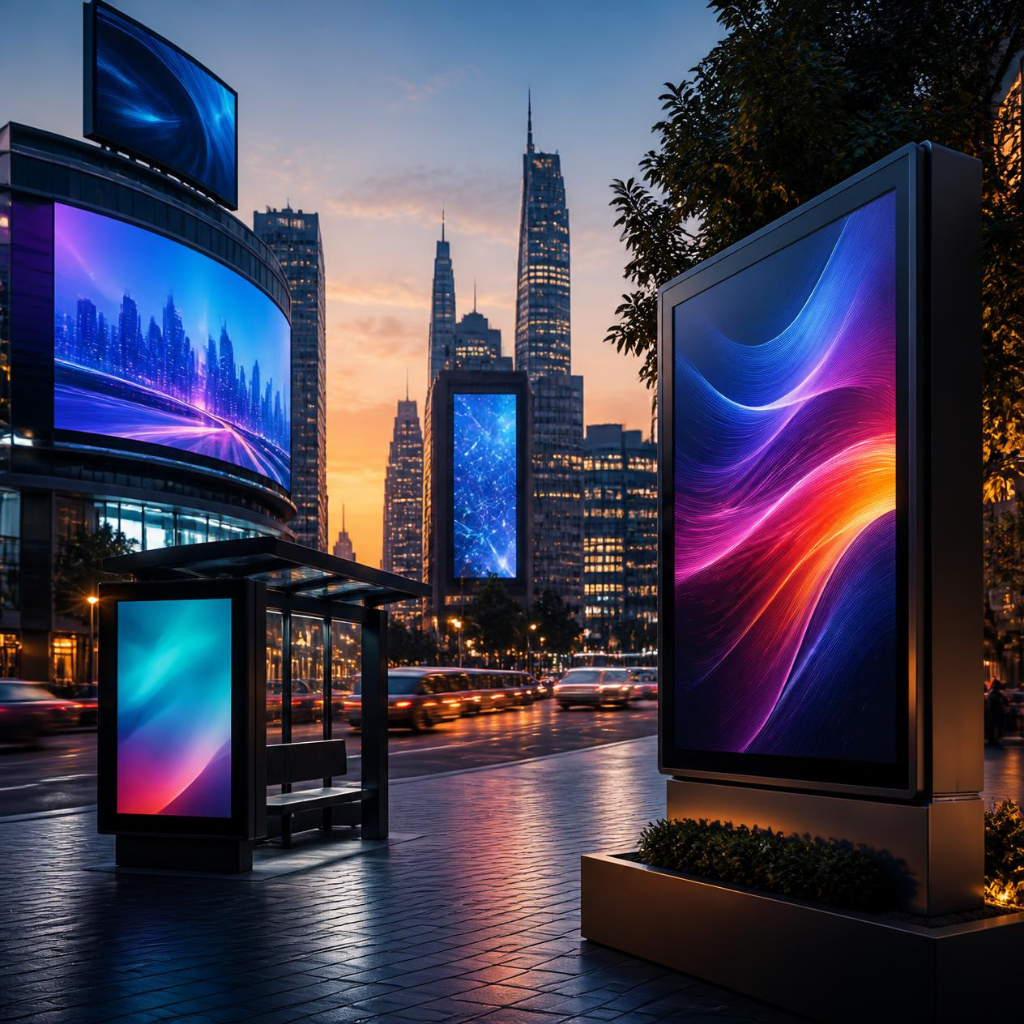
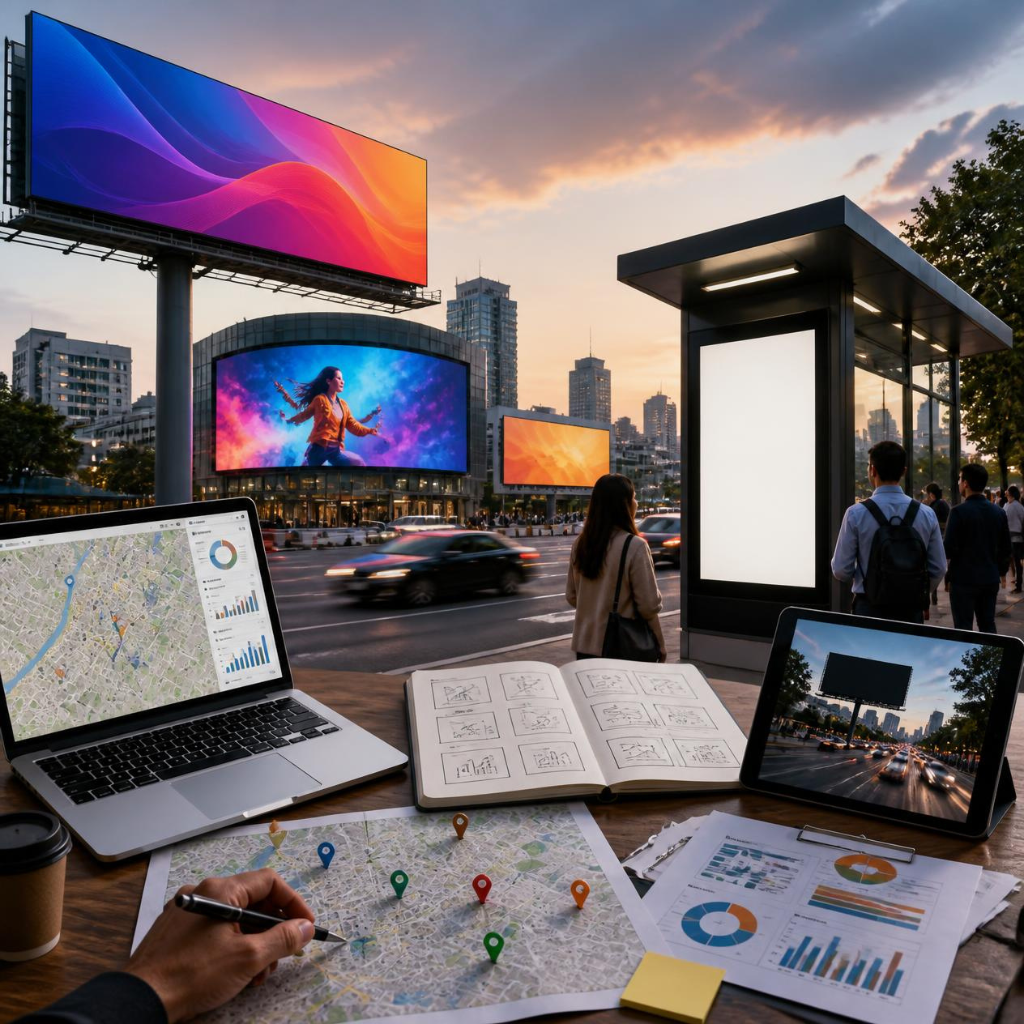
That basic idea became out-of-home advertising—commonly called OOH—and it remains the foundation of the medium today. OOH includes billboards, transit advertising, street furniture, airport media, place-based screens, wallscapes, kiosks, and other advertising encountered outside the home.
Although the technology has changed dramatically, the purpose has remained remarkably consistent: help businesses, organizations, and public agencies reach people in shared public spaces.
The beginning of out-of-home communication
The roots of OOH stretch back thousands of years. Ancient civilizations used public monuments and signs to communicate laws, announcements, and commercial information. The Out of Home Advertising Association of America notes that ancient Egyptians used tall stone obelisks to publicize laws and treaties—an early example of placing important messages where communities could see them.
Modern advertising began taking shape after Johannes Gutenberg developed movable-type printing around 1450. Printed handbills made it possible to reproduce messages and distribute them more widely. The perfection of lithography in 1796 then made illustrated posters practical, giving businesses and event promoters a more colorful, attention-grabbing way to communicate.
In the United States, early roadside advertising was primarily local. Merchants painted signs or attached posters to walls and fences to tell travelers what products or services were available nearby. These messages solved a practical problem: before electronic communication, businesses needed to alert people passing through an area that a store, product, attraction, or event existed.
The large-format American poster began to emerge in New York in 1835, when printer Jared Bell produced circus posters measuring more than 50 square feet. Circuses traveled from city to city and needed a fast, highly visible way to create awareness and attract large audiences. Bigger posters could be seen from farther away and could deliver a message quickly to pedestrians and travelers. In 1850, exterior advertising appeared on street railways, extending advertising into public transportation.
Why out-of-home advertising was created
OOH developed because businesses needed to communicate with a mobile public. It served several important purposes:
- To announce where goods and services could be found
- To promote entertainment, events, and new products
- To direct travelers toward nearby businesses
- To reach many people with one public message
- To build recognition through repeated exposure in the same location
Unlike a handbill that could be discarded, a poster or sign placed along a busy route could remain visible for days or weeks. Advertisers soon recognized the value of high-traffic locations, and bill posters began building their own structures in places with heavy pedestrian and vehicle movement. The earliest recorded leasing of billboard space occurred in 1867. By 1870, nearly 300 sign-painting and bill-posting companies were operating in the United States.
This change was important: outdoor advertising was becoming an organized media business rather than simply a collection of painted signs.
From local posters to a national advertising medium
The next major step was standardization. In 1900, the American industry established a standardized billboard structure. Advertisers could now create one design knowing that it would fit structures in markets across the country. National brands such as Coca-Cola, Kellogg, and Palmolive began mass-producing billboard campaigns, and by 1912 standardized outdoor advertising services were available in nearly every major U.S. urban center.
OOH also became a tool for public communication. Beginning in the early 20th century, the industry encouraged companies to donate unused billboard space for public-service messages. Outdoor displays later supported wartime communications and peacetime causes, demonstrating that the medium could inform communities as well as sell products.
Measurement followed growth. In 1934, the Traffic Audit Bureau for Media Measurement was created to provide third-party audience data. This marked an important progression: advertisers increasingly wanted evidence of who could see their campaigns, not simply a promising location.
New formats, public infrastructure, and regulation
OOH continued to expand beyond the traditional roadside billboard. In 1962, JCDecaux introduced the advertising-supported bus shelter. The model allowed municipalities to receive useful street furniture without paying the full construction and maintenance cost, while advertising revenue supported the infrastructure. Bus shelters would become one of the most familiar forms of street-level advertising.
As roadside advertising grew, so did concerns about visual clutter and highway safety. The Highway Beautification Act of 1965 created federal controls for billboards along interstate and federal-aid primary highways. It required states to regulate elements such as sign size, lighting, and spacing in controlled areas. Regulation helped shape where and how OOH inventory could operate.
Production also improved. Research into computerized billboard painting in the 1970s eventually supported printing on vinyl, making large advertisements easier to produce, transport, install, and replace. New formats—including transit displays, airport media, street furniture, cinema advertising, wallscapes, and place-based media—expanded the environments in which brands could reach consumers.
The digital transformation of OOH
The first digital billboards were installed in the United States in 2005. Digital out-of-home advertising, or DOOH, changed the medium from a largely fixed display into a flexible communications platform.
A printed billboard generally displays one creative for a contracted period. A digital screen can rotate multiple advertisers, update messages quickly, and use creative triggered by factors such as time, weather, location, or live information. Programmatic technology has made portions of digital inventory easier to plan, purchase, and optimize through automated platforms.
Measurement has advanced as well. Modern OOH planning can use audited audience estimates, mobility patterns, geographic data, campaign exposure models, and brand-lift or visitation studies. QR codes, search activity, website visits, app downloads, and store traffic can help connect a public display with measurable consumer action.
OOH is therefore no longer isolated from digital marketing. A person may see a transit ad, search for the brand on a phone, visit its social page, and later make a purchase. The physical exposure can begin a digital customer journey.
The state of out-of-home advertising today
Today’s OOH industry combines the scale of a public medium with many of the targeting, flexibility, and measurement capabilities associated with digital advertising.
The latest U.S. figures show significant momentum. According to OAAA:
- U.S. OOH revenue reached a record $9.46 billion in 2025, an increase of 3.6% from 2024.
- Digital OOH represented 36.3% of 2025 U.S. OOH revenue and grew 10.5% year over year.
- Transit was the fastest-growing major U.S. segment in 2025, increasing 9.2%.
- In the second quarter of 2026, U.S. OOH revenue rose 10.7% year over year to $3.16 billion—the first quarter in which the industry exceeded $3 billion.
- DOOH grew 18.5% in Q2 2026 and accounted for 38.4% of quarterly U.S. OOH revenue.
- Transit revenue increased 23.9% and place-based media increased 19.3% in Q2 2026.
The global market is also expanding. The World Out of Home Organization reported that global OOH spending reached $54.2 billion in 2025, up 15% from 2024, and represented 5.1% of total global advertising expenditure. Its first global programmatic DOOH measurement estimated approximately $1.4 billion in programmatic DOOH spending in 2025, equal to 7% of total DOOH expenditure.
Consumer research helps explain why brands continue investing. In a 2024 OAAA/Harris Poll study, 73% of consumers viewed DOOH favorably, while 76% of recent DOOH viewers said a digital OOH ad had prompted them to take action. In addition, 74% of mobile-device users reported taking an action on their phone after recent DOOH exposure. These results show how physical media and mobile behavior can work together.
Why OOH remains relevant
OOH has survived every major change in media because it occupies something no other channel can fully reproduce: real-world space. People cannot skip a billboard, block a bus-shelter display, or scroll past an airport screen in the same way they can avoid an online ad. At the same time, effective OOH does not need to interrupt content; it becomes part of a person’s surroundings and daily movement.
For emerging businesses, OOH can create legitimacy and visibility in a specific neighborhood. For established brands, it can build mass awareness across an entire market. For retailers and service businesses, it can influence people near the point of purchase. And when a creative idea is memorable, the display can earn a second audience through photographs, videos, news coverage, and social sharing.
The medium has progressed from hand-painted local signs to connected digital networks, but its central strength has not changed: OOH places a brand in the public world, where culture, commerce, and everyday life meet.
The next chapter of out-of-home advertising
The future of OOH is likely to be more responsive, measurable, and integrated. Digital screens will continue expanding. Programmatic purchasing should make selected inventory more accessible and adaptable. Better measurement will help advertisers understand how OOH contributes to awareness, web activity, store visits, and sales. Creative campaigns will increasingly connect physical displays with mobile, social, experiential, and commerce strategies.
Out-of-home advertising began because businesses needed to reach people on the move. Nearly two centuries after America’s first large-format posters, that need is stronger than ever. Audiences may move through the world differently today, but they still move—and OOH continues to meet them there.
Ready to make your brand visible in the real world? Sync it Media helps businesses plan and place strategic out-of-home campaigns across billboards, street furniture, transit, airport media, and other high-impact formats. Contact us to explore the right locations and media mix for your goals.
Sources
- Out of Home Advertising Association of America, “History of OOH”: https://oaaa.org/resources/history-of-ooh/
- OAAA, “Out of Home Advertising Revenue Reaches Record $9.46 Billion,” March 17, 2026: https://oaaa.org/news/out-of-home-advertising-revenue-reaches-record-9-46-billion/
- OAAA, “From Coca-Cola to OpenAI, Brands Are Betting Bigger on OOH,” August 18, 2026: https://oaaa.org/news/from-coca-cola-to-openai-brands-are-betting-bigger-on-ooh/
- OAAA, “New Study Finds Digital Out of Home Advertising Surpasses Other Media,” April 30, 2024: https://oaaa.org/news/new-study-finds-digital-out-of-home-advertising-surpasses-other-media-in-driving-favorability-and-action-among-consumers/
- World Out of Home Organization, “WOO Global OOH Expenditure Report 2026”: https://www.worldooh.org/news/woo-global-ooh-expenditure-report-2026
- World Out of Home Organization, “Global pDOOH Spend Hit $1.4bn in 2025”: https://www.worldooh.org/news/woo-global-pdooh-spend-study-2025